Your Go-To for Complete Home Solutions and Trusted Excellence
Your Go-To for Complete Home Solutions and Trusted Excellence
Siding

By Ar. Daisy,
April 30, 2026


If you are wondering how much does siding cost for a house, you are not alone. This is among the most popular searches related to improving your home. Most homeowners look for it often. Since siding involves a significant expense, it is important to consider the pricing factor. It is a key as it impacts your home’s durability, energy efficiency and resale value.
In the United States, the typical cost of siding a house is between $5 and $15 per square foot of installed siding, with total project costs ranging from $8,000 to $25,000+.
The cost of siding installation varies significantly based on the material, home size, and complexity of the project.
Homeowners want to know “how much does new siding cost for a house”? The cost of siding a house depends heavily on the material you choose. Here is a breakdown of common house siding prices in the USA:
✔ Vinyl siding: $5– $10 per sq ft
✔ Fiber cement siding: $6– $15 per sq ft
✔ Wood siding: $2– $14 per sq ft
✔ Metal siding: $8– $16 per sq ft
✔ Brick/stone veneer: $10– $25+ per sq ft
These estimates of how much does siding costs for a house align with data published by HomeAdvisor, which tracks the cost across the United States.
When homeowners search for how much does vinyl siding costs, they are usually looking for a budget-friendly option for their house and vinyl just delivers that.
Out of all the other options available and different types of sidings, like wood, brick, metal etc, vinyl stands out. It is a long-lasting and low-maintenance option.
According to Angi, vinyl siding is one of the most affordable siding materials available.
For an average home, total vinyl siding cost ranges from $8,000 to $16,000, depending on labor and additional features like insulation or trim.
The price to side a house increases with square footage. Based on industry averages, these are the estimated range and cost of siding a house:
These reflect the combined costs for how much siding costs for a house, which are based on materials, labor, and installation, using national averages from HomeAdvisor and Angi.
Even for similar homes, the cost for siding can vary significantly. Here are the key factors to keep a note of when looking for the cost of siding a house:
Different materials vary in price and durability. Vinyl is the most affordable option, while fiber cement and stone are more expensive but offer longer-lasting durability. Wood could be a more aesthetic and appealing option, but it is subject to rot and termites due to environmental factors.
Labor accounts for 30% to 50% of total siding costs. Complex installations increase the siding cost or multi-story homes increase labor expenses. So, it is essential to check with the local service provider beforehand so that you get the best deal, as per your budget and preference.
Removing existing siding adds $1,000 to $3,000 to the total project cost. So, it's better to check if you want to go for a repair of old siding or a replacement with a new one in case it's non-fixable.
If structural repairs or insulation upgrades are needed, the average siding replacement costs will increase. Keeping a check on it matters for homeowners to better adjust to their home improvement requirements.
Material availability and labor rates vary across states, impacting overall house siding costs. The more readily the material is available, the cheaper it can be.
Replacing siding is typically more expensive than installing it on a new home. This is primarily because of the additional work involved. In a replacement project, the local siding contractor removes the existing siding, which adds to the labor cost and complexity. This is followed by disposal cost, which depends on regulations and landfill fees.
In many cases, the underlying issue of wall repair also occurs. This is especially true in the case of there having been rot or moisture damage.
So, the average cost to replace siding on a home includes:
According to Angi, full siding replacement projects generally range between $10,000 and $22,000, depending on materials and home size.
Yes, siding is a valuable investment for homeowners and it's for a good reason. Beyond simply improving the home’s curb appeal, it also enhances the overall performance of the house. It acts as a strong barrier against the harsh weather conditions like rain, storms, winds and temperature fluctuations too. Also, it helps in managing the insulation. Thus, this energy efficiency leads to better savings on heating and cooling costs over time
Moreover, it boosts the property value too, making it an attractive upgrade for those considering resale in the future.
According to Remodeling Magazine’s Cost vs Value Report, siding replacement consistently ranks among the top home improvement projects for return on investment. This reinforces its long term financial benefits.
Quick Cost Summary
The cost of installing siding varies significantly in all of the United States due to differences in the cost of labor, climate conditions, permits, and the availability of materials. Homeowners living in coastal or high-cost metropolitan areas typically spend more than homeowners in the Midwest or Southern states.
|
State |
Average Siding Cost (2,000 sq ft Home) |
Common Siding Choice |
|
$14,000 – $28,000 |
Fiber Cement, Stucco |
|
|
$10,000 – $22,000 |
Vinyl, Fiber Cement |
|
|
$11,000 – $24,000 |
Vinyl, Impact-Resistant Siding |
|
|
$12,000 – $25,000 |
Insulated Vinyl |
|
|
$13,000 – $30,000 |
Fiber Cement, Brick Veneer |
|
|
Ohio |
$9,000 – $18,000 |
Vinyl |
|
Arizona |
$8,500 – $17,000 |
Stucco, Metal |
|
Colorado |
$12,000 – $26,000 |
Engineered Wood |
|
Washington |
$13,000 – $27,000 |
Fiber Cement |
|
Georgia |
$9,500 – $20,000 |
Vinyl |
In colder states like Illinois and Minnesota insulation is becoming more popular as homeowners require better thermal efficiency in long winters. In areas that are prone to hurricanes, such as Florida as well as those along the Gulf Coast, impact-resistant siding is typically preferred due to its the durability and compliance with insurance requirements.
If homeowners are asking how much siding will cost for a home it is essential to know that the total costs include both materials as well as labor.
Typically:
|
Expense Type |
Percentage of Total Cost |
|
Siding Materials |
50% – 70% |
|
Labor & Installation |
30% – 50% |
As an example, in the basis of a siding replacement project worth $16,000:
The cost of labor increases as:
According to contractors from their region in the Midwest and Northeast Fiber cement siding installations typically require greater labor due to the fact that the material is heavy and more time-consuming to cut and install compared to vinyl siding.
The new siding isn't just an improvement in appearance. It's also one of the best projects for exterior renovations in the United States.
Based on Remodeling Magazine’s Cost vs Value Report:
|
Siding Type |
Average ROI |
|
Vinyl Siding Replacement |
75% – 85% |
|
Fiber Cement Siding |
80% – 90% |
This means that homeowners will be able to get back a substantial portion of their investment through resales.
Apart from increasing resale value the new siding offers:
Real estate professionals are often aware that damaged or worn-out siding can affect buyer perception, particularly in highly competitive housing markets.
Many homeowners struggle with the decision of whether to repair their siding or have it replaced completely.
The typical cost for siding repairs:
Contractors frequently explain that frequent repairs to patch holes can become more costly than a complete replacement, particularly if water begins to damage the structural sheathing of your home.
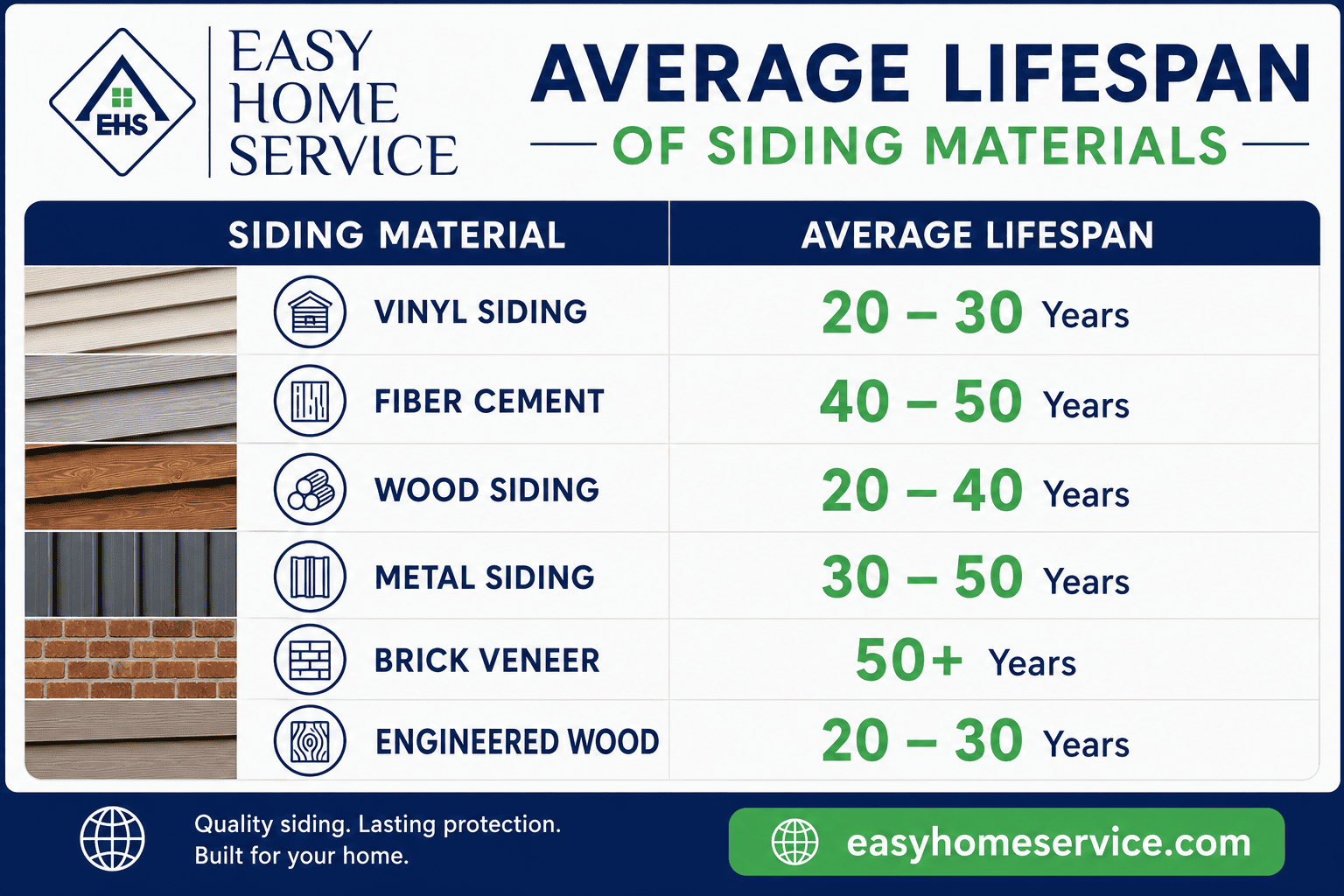
The lifespan of siding depends heavily on material quality, climate conditions, and maintenance.
|
Siding Material |
Average Lifespan |
|
Vinyl Siding |
20 – 30 Years |
|
Fiber Cement |
40 – 50 Years |
|
Wood Siding |
20 – 40 Years |
|
Metal Siding |
30 – 50 Years |
|
Brick Veneer |
50+ Years |
|
Engineered Wood |
20 – 30 Years |
In areas with high humidity, snow accumulation salt air, extreme UV exposure could be more prone to wear and tear.
Professional contractors advise annual inspections that identify:
The early maintenance of siding can greatly prolong the life of siding.
In areas with high humidity, snow accumulation salt air, extreme UV exposure could be more prone to wear and tear.
Professional contractors advise annual inspections that identify:
The early maintenance of siding can greatly prolong the life of siding.
Here are estimated siding installation costs based on average home size and material type.
|
Home Size |
Estimated Cost |
|
1,000 sq ft |
$5,000 – $10,000 |
|
1,500 sq ft |
$7,500 – $14,000 |
|
2,000 sq ft |
$10,000 – $18,000 |
|
2,500 sq ft |
$13,000 – $24,000 |
|
Home Size |
Estimated Cost |
|
1,000 sq ft |
$8,000 – $15,000 |
|
1,500 sq ft |
$12,000 – $22,000 |
|
2,000 sq ft |
$15,000 – $30,000 |
|
2,500 sq ft |
$20,000 – $38,000 |
These estimates include:
Complex architectural designs or premium finishes may increase pricing further.
Numerous counties and cities in the USA require permits prior to large-scale siding repair projects can begin.
Average siding permit costs:
The price of permits is based on:
Professional siding contractors usually handle permit applications for homeowners.
Skipping permits can create issues during:
Costs for siding fluctuate throughout the year depending on the demand of contractors and the weather conditions.
In many states in the northern part of the country winter installation may be possible using engineered and vinyl siding when the weather is manageable.
Contractors frequently claim that homeowners could save between 5 and 15% in slow seasons by negotiating lower prices and availability of workers.
According to seasoned siding contractors, one of the most significant hidden costs associated with siding replacement projects is the underlying wall damage that is discovered following old siding.
For instance:
An owner in Illinois initially was given an estimate of $14,000 for vinyl siding. After the contractors had removed the siding, they discovered water damage and decayed sheathing beneath the exterior walls. The structural repairs pushed the total cost of the project to more than $18,000.
A homeowner from Florida moved from vinyl siding, to impact-resistant siding after numerous claims of storm-related damage. Even though the initial cost increased by around 20 percent, the homeowner decreased cooling costs and increased storm protection.
These scenarios from the real world illustrate the need for homeowners to budget an extra 10%-15% of contingency for repairs that might be unexpected for siding replacement projects.
Before deciding on a siding material homeowners should consider:
Many contractors with experience recommend:
Choosing the appropriate siding not just about upfront costs It's about balancing the long-term value and durability, as well as energy savings and maintenance costs in the coming 20-40 years.
If you are trying to determine how much it costs to side a house or how much does siding cost for a house, the final price depends on your material choice, labor costs, and home size. While siding requires a significant upfront investment, it delivers long-term benefits in durability, energy efficiency and property value. All these contribute and make it a practical and rewarding upgrade.
To maximize your investment, it is important to compare multiple contractor quotes, select materials suited to your local climate and work with experienced professionals who are well-reviewed. This ensures quality installation and lasting results.
For the best results, this is where Easy Home Service comes in as a helpful platform. We help homeowners in the USA connect with reliable siding professionals without hassle. Just fill in a quick form requesting your service and compare multiple quotes and we will get you matched with experienced service providers. It's simple and fast. So, don't wait, get a quote now.
The cost of installing siding on a 2,000 square foot home typically ranges from $10,000 to $25,000 depending on the siding material, labor costs, and the condition of the existing exterior. Vinyl siding is usually the most affordable option, while fiber cement, wood, and brick veneer cost more due to higher material and installation expenses.
Yes, vinyl siding is generally more affordable than wood siding. Vinyl has a lower upfront cost, requires less maintenance, and does not need frequent painting or sealing. Wood siding offers a more natural appearance, but it usually costs more to install and maintain over time.
Vinyl siding is considered the most affordable and budget-friendly siding option for homeowners. It is durable, easy to maintain, and available in many colors and styles. For homeowners looking to improve curb appeal without spending too much, vinyl siding is often the preferred choice.
Yes, vinyl siding can be painted if it is still in good condition. Many homeowners paint older vinyl siding to refresh the appearance of their home without replacing the entire exterior. It is important to use high-quality exterior paint specifically designed for vinyl siding and avoid choosing colors that are significantly darker than the original siding color, as darker shades may absorb excess heat and cause warping.
The lifespan of siding depends on the material, climate, and maintenance. Vinyl siding generally lasts 20–30 years, while fiber cement and metal siding can last 40–50 years or longer. Wood siding may also last for decades with proper maintenance, including regular painting and moisture protection. Routine inspections and repairs help extend the life of any siding material.
Find Top Rated Service Providers
We help you find top service providers and compare quotes.












Leave a Comment: