Your Go-To for Complete Home Solutions and Trusted Excellence
Your Go-To for Complete Home Solutions and Trusted Excellence
HVAC

By Ar. Daisy,
June 23, 2026



It's late July; the AC in a Spring Branch home fails around 4 p.m., and by 9 p.m., the indoor temperature has risen above 85°F. That's usually when Houston homeowners start seriously considering HVAC installation, despite the fact that planning ahead of time is a better idea. Houston's climate does not leave forgiving margins for an ageing system, and waiting for a complete breakdown almost always results in paying rush pricing for a decision that deserved more time. This guide explains what HVAC installation services in Houston entail – what factors influence the price, what an install day looks like, and how to avoid contractors who cut corners on a job that should last fifteen years.
The Primary Reason Houston HVAC Systems Deteriorate More Quickly
Houston's climate creates unique challenges for residential HVAC systems. Unlike many parts of the country, air conditioning is used for much of the year due to the city's long, hot, and humid summers. High humidity forces HVAC systems to work harder to maintain indoor comfort, while prolonged operating hours can increase wear and tear. Homes near the Gulf Coast may also experience faster corrosion of outdoor components because of salt-laden air, making regular maintenance and proper system selection especially important. Additionally, homes situated closer to the coast face an extra challenge: salt-laden air that accelerates the corrosion of outdoor coils more rapidly than in properties located further inland. During a Texas summer, attic temperatures frequently exceed 130°F, meaning that even the indoor components are contending with heat from two different sources simultaneously.
Houston's climate creates unique challenges for residential HVAC systems. Air conditioning often runs for extended periods throughout the year, making efficiency and reliability critical for homeowners.
An ageing or improperly sized system can lead to:
1. Uneven temperatures between rooms
2. Higher monthly energy costs
3. Excess indoor humidity
4. Frequent repairs
5. Reduced indoor comfort
6. Shortened equipment lifespan
A professionally planned HVAC installation helps ensure your system can handle Houston's demanding weather while maintaining consistent comfort throughout your home.
The decision is rarely based on a single dramatic failure. It usually follows a pattern: a unit that has passed the 12-year mark, a second repair visit in the same season, a bedroom that is never quite comfortable regardless of the thermostat setting, and a power bill that has risen without any significant change in household habits. Older systems still using outdated refrigerant add another wrinkle, as replacement parts for that refrigerant type become more difficult to obtain and more expensive when they are available at all.
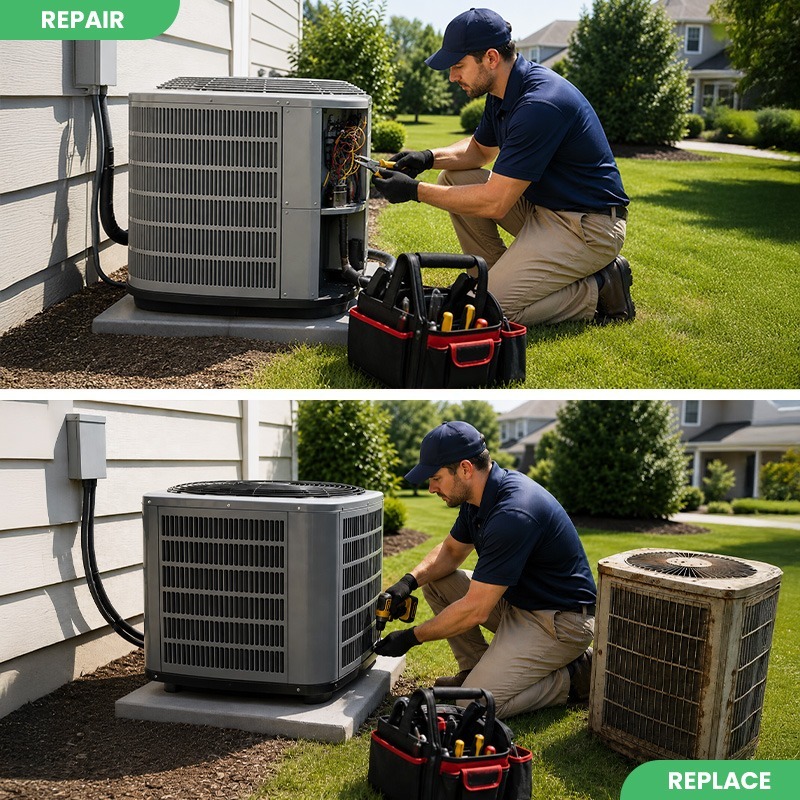
A simple way to decide whether to repair or replace your HVAC system is to look at its age and the repair cost, so if you have a 15-year-old HVAC system and the repair is estimated to cost $600, it may be time to replace the system rather than put more money into a system that will need to be replaced soon anyway. Although a repair might fix the immediate problem, it will not stop other parts from wearing out or breaking down soon. Replacing an older system can prevent you from having to pay for repeated repairs and will make the system more energy efficient.
Getting a second opinion costs nothing – a bad installation costs years Before you decide on a system size, brand, or contractor, it helps to hear from someone who's already done the math on Houston homes. Easy Home Service connects you with local HVAC professionals who can look at your specific setup, square footage, insulation, ductwork age and tell you what actually makes sense, not just what's in stock. No pressure, no commitment, just real answers before you spend real money.
Most homeowners never see what happens between dropping off a deposit and flipping the new thermostat on, so here's the short version. The crew typically starts with a walkthrough confirming the equipment, location, and any ductwork changes discussed at the quote. Electrical connections are disconnected at the breaker first, and refrigerant lines are appropriately depressurised before old equipment is disconnected and removed. The new outdoor unit and indoor air handler or furnace go in, ductwork gets connected and sealed at each joint, and electrical and refrigerant lines get run and tested. Once everything's connected, the system gets charged to the manufacturer's spec, started up, and checked room by room for airflow. The visit usually wraps with thermostat programming and a final walkthrough explaining what was done and what to expect over the first few weeks.
A straightforward job like this typically finishes in a single day. Anything involving major ductwork rework tends to run longer.
Pricing rarely comes down to one factor. The size of the system needed for your home is one of the biggest factors affecting HVAC installation cost. From there, ductwork condition matters: a system going into ducts that are already sealed and correctly sized installs faster than one requiring runs to be rebuilt. Equipment efficiency tier shifts the number too, since higher-efficiency units cost more upfront but tend to earn that difference back faster here than in milder climates. Attic accessibility, the need for an electrical panel upgrade, and second-story installs each push the total in their own direction.
A standard swap with no major ductwork involved generally runs somewhere between $6,000 and $9,500 for a full system in the Houston area. Homes needing duct repairs, a higher-efficiency unit, or multiple zones can see that climb past $12,000. Smaller ductless setups for additions or converted rooms are priced separately and scale with the number of zones. Financing through the installing contractor is common for homeowners who'd rather spread a larger expense across monthly payments. None of these numbers replace an actual in-home estimate, since the only accurate price comes from someone who's measured the specific space.
AC installation only refers to the cooling side, which includes the outside condenser and the indoor coil. That's a reasonable choice when the furnace or air handler is newer and has plenty of useful life left. A full system replacement swaps both halves together, and there's a real reason to consider it even when only one side is failing: pairing an old air handler with a new condenser, or vice versa, almost always means the combined system runs below its rated efficiency. Components engineered to work as a matched pair tend to underperform when mismatched, and that gap shows up directly on monthly bills. It can also shorten the lifespan of whichever piece is newer, since it's effectively being asked to compensate for a partner that's already wearing down. A contractor worth listening to will flag this tradeoff during the quote instead of letting a homeowner find out the hard way a year or two later.
A lower quote isn't automatically a worse one, but it's worth understanding what's being skipped to hit that number. A contractor who skips a load calculation, eyeballs the tonnage based on the old unit, or rushes through duct inspection is setting up a system that may run, technically, but never quite right. The ones worth hiring ask questions before quoting about which rooms run hot, how old the ductwork is, and whether the attic insulation has ever been upgraded and explain their equipment recommendation instead of just pointing at the most expensive option. They're also comfortable putting that reasoning in writing, rather than leaving it as something said once during the walkthrough and never mentioned again.
It's important to spot a few trends early on, such as the absence of an in-home visit prior to the delivery of a quote, the absence of a written estimate that breaks down labour versus equipment, the pressure to sign before the visit is over, or a warranty promise that seems exceptionally generous in comparison to other bidders. While none of these alone ensures a negative result, taken as a whole, they represent a pattern to be aware of.
A proper installation does not conclude when the team departs. Quality HVAC services in Houston generally involve a follow-up inspection within the initial month to ensure the system is functioning as anticipated, comprehensive documentation of model numbers and warranty conditions provided to the homeowner, and a suggestion for HVAC maintenance tips instead of a vague "Contact us if there are issues." Homeowners who receive this documentation in advance often find it significantly easier to address any warranty claims that may arise in the future.
A new system is only as good as the upkeep around it. Here, filters should be checked every month rather than every three months since Houston's dust and pollen loads clog them more quickly than in dry regions. Airflow is maintained where it should be by leaving at least two feet of space around the outdoor unit, free of overgrown plants and piled patio furniture. An annual tune-up catches small issues, like a slightly low refrigerant charge, before they become a midsummer emergency call. It's also worth keeping outdoor drainage clear, since heavy rain runoff pooling near the unit can lead to corrosion issues that have nothing to do with the equipment itself.
Comparing contractors, combing through bids, and determining who's genuinely worth a call takes time most people don't have, especially during a week when the AC decides to quit. Easy Home Service handles the matching part. A homeowner enters a zip code, describes what's going on, and gets connected with HVAC professionals already working across Houston and the broader Texas area. There's room to compare more than one option before committing to anything, and nobody's required to decide on the spot. For homeowners juggling work, family, and a house that's currently 85°F, skipping the research-everyone-yourself step is often the biggest relief in the whole process.
The homeowners who end up happiest with a new system are rarely the ones who waited for a total failure. Planning, even a season before the old unit is expected to give out, leaves room to compare contractors properly, ask the right questions, and choose equipment actually sized for the house instead of whatever's in stock that week. Houston's climate isn't going to get any gentler, but a properly planned HVAC installation can mean a decade or more of steady comfort without the scramble.
In the long run, homeowners who plan often enjoy a smoother installation process and better system performance. If you're ready to compare real quotes, Easy Home Service can connect you with HVAC professionals serving the Houston area.
Need qualified heating and air conditioning installation, maintenance, and repair services? Check out HVAC services in Houston today to compare the best and most well-known of all service providers in your city to have a better comparison of service providers.
The wrong HVAC installation doesn't fail all at once. It just quietly costs you more every single month until it does. Easy Home Service matches Houston homeowners with vetted HVAC professionals who size, quote, and install for your actual house, not a textbook average. Share your zip code and what's going on, compare your options, and pick who you want. The whole process takes minutes and the right system lasts a decade.
Even if your HVAC system is still operational, it’s wise to request an estimate when multiple warning signs appear together, such as rising utility bills, uneven cooling, or recurring repairs. Waiting until the system completely fails often limits your options and can result in higher replacement costs.
Choosing the correct HVAC size involves more than square footage. Factors such as insulation levels, ceiling height, window placement, sun exposure, and home layout all influence system sizing. A professional load calculation ensures the unit delivers optimal comfort and efficiency.
Most standard HVAC replacements can be completed within a single day. However, projects involving ductwork modifications, electrical upgrades, zoning systems, or other custom requirements may require an additional day to complete properly.
A commonly used rule is to multiply the age of the HVAC system by the estimated repair cost. If the result approaches $5,000 or more, replacing the unit often provides better long-term value than continuing to invest in repairs.
Most complete HVAC system installations range from $6,000 to $12,000 depending on the equipment selected, home size, energy-efficiency rating, and ductwork condition. Advanced zoning or ductless systems may cost more.
Not always. Some contractors include ductwork inspection in their installation package, while others charge separately. It’s important to confirm what is included in the quote before approving the project.
Spring and fall are generally the best seasons for HVAC installation. During these periods, contractors often have greater availability, and homeowners can avoid the rush associated with peak summer and winter demand.
Many utility providers and government programs offer rebates for installing high-efficiency HVAC equipment, including certain heat pumps. Available incentives change periodically, so ask your contractor about current rebate opportunities before making a final decision.
Find Top Rated Service Providers
We help you find top service providers and compare quotes.











Leave a Comment: