Your Go-To for Complete Home Solutions and Trusted Excellence
Your Go-To for Complete Home Solutions and Trusted Excellence
HVAC

By Ar. Daisy,
August 03, 2026


Most homeowners don’t even know that their house can be too airtight.
Modern windows, better insulation, weather stripping, and energy-efficient building practices all reduce the cost and energy requirements of heating and cooling. The trade-off is that there are fewer natural ways for fresh outside air to get into your home. This can mean that instead of venting out, moisture, cooking smells, cleaning chemicals, pet dander and airborne particles become trapped inside your home.
A bedroom always feels stuffy. Mirrors in the bathroom fog up long after you finish a shower. Windows show condensation in the winter. The upstairs always feels warmer than the rest of the house. Someone in the family continues to experience allergy flare ups even though HVAC filters are being changed regularly.
This is not always an HVAC issue. In fact, for most homes, these are indicators that your home isn’t getting good ventilation between indoor and outdoor air.
Enter whole house ventilation installation. Instead of relying on random cracks in your walls, or open windows, a professionally designed and installed ventilation system pushes fresh air into your home while extracting stale, old air in a controlled, energy-conscious manner.
This is exactly where whole house ventilation installation comes in. It's not a luxury upgrade. For a lot of homes, it's the missing piece that makes everything else, your air conditioning, your air quality, your comfort, actually work the way it's supposed to. If you're weighing your options, our team at whole house ventilation solutions can walk you through what makes sense for your specific home, but let's start with the basics so you know what you're actually choosing between.
A whole house ventilation system is an indoor/outdoor mechanical air exchange system that continuously supplies fresh outdoor air while exhausting stale indoor air from an entire home – not just one room or a single problem area. A home ventilation system is unlike a single room exhaust fan or a window you “crack open” to get away from a bad odor: it operates on a programmed schedule (or continuously, depending on your system) to forcibly eliminate old indoor air and replace it with fresh outdoor air in a reliable, measured fashion.
Consider your house as a sealed container. Cooking, showering, breathing, cleaning products, and even your furniture all contribute to the moisture and airborne particles in that sealed container. In an older home with gaps around windows and doors, that air is partially vented and replaced by outdoor air. In a newer, insulated house, it isn’t. It just stays there.
A residential ventilation system provides a cleaner air replacement by giving the stale air a responsible way out and fresh air a responsible way in, automatically.
Many homeowners don't think about ventilation until they get mold.
In fact, poor air exchange often becomes apparent far earlier.
Check for these symptoms:
Rooms that smell stale after being shut overnight
Condensation forming on windows quite often
Bathrooms that stay humid for a long time after a shower
Uneven humidity levels between floors
Lingering cooking odors
Musty closets or storage areas
Allergy symptoms that improve when out in the open
An excessive amount of dust just after cleaning
Individually they may all seem unimportant. But all of them at once may indicate you're not ventilating your home adequately.
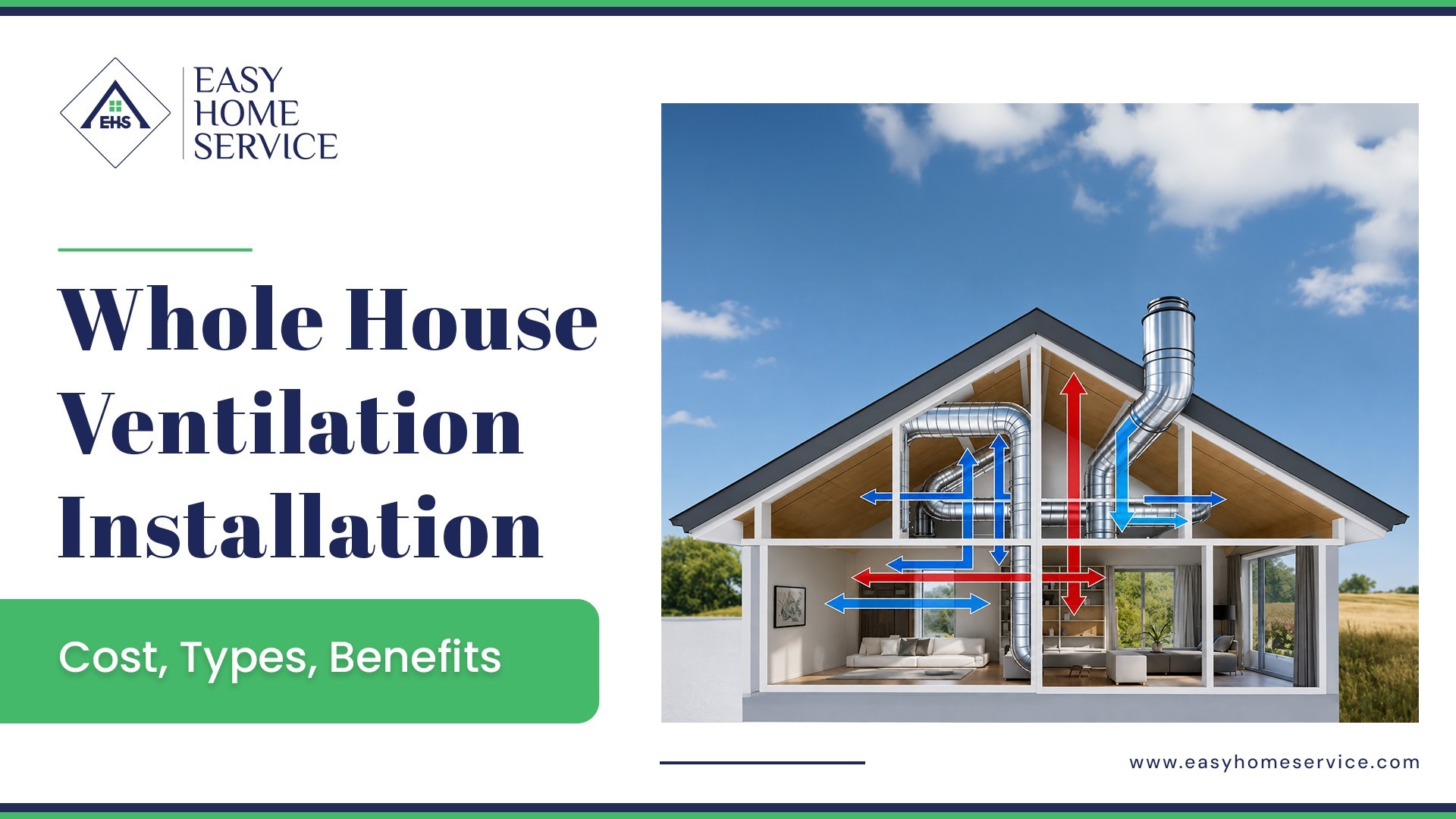
What is the actual operation of a full house ventilation system? Fundamentally, the system moves air in a controlled loop using ductwork, fans, and occasionally heat exchange components.
Here's the basic cycle:
Stale, humid interior air is drawn from places like restrooms, kitchens, and laundry rooms where contaminants and moisture are concentrated.
That air is exhausted outside.
Fresh air from outside is pulled into, filtered and in a variety of systems, it is tempered to ensure that it's not blasting cold and hot air into your home.
The fresh air is distributed through supply ducts into bedrooms, living rooms, and other occupied spaces.
The more advanced systems, ERVs and HRVs in particular, add one more step. Before the incoming and outgoing air streams pass each other, they run through a heat exchange core. That core transfers heat (and in ERVs, some humidity) from the outgoing air to the incoming air, so you're not paying to heat or cool a constant stream of raw outdoor air. It's a genuinely clever piece of engineering, and it's the reason these systems have become the standard recommendation for tightly sealed modern homes.
Every day without proper ventilation, your home is trading fresh air for stale air and losing. Find out what it actually takes to fix that.
Not every home needs the same setup. There are four main approaches, and the right one depends on your climate, your home's construction, and your budget.
This is the simplest approach. A central fan (or several smaller fans) pulls stale air out of the house, typically from bathrooms and utility rooms, and vents it outside. Fresh air is drawn in passively through small vents, gaps, or a passive air inlet. It's affordable and straightforward, but it offers less control over where fresh air actually enters, and in humid climates it can pull moisture in through wall cavities.
This works the opposite way. A fan brings filtered outdoor air into the home and distributes it through the duct system, while stale air escapes passively through exhaust points and small leaks. Supply systems give you more control over air filtration and pressurization, which some homeowners prefer, especially in areas with outdoor air pollution or pollen concerns.
The balanced system of ventilation employs separate airflow fans for intake and exhaust, ensuring that air flows in and out in roughly equal amounts. This eliminates the pressure imbalances that exhaust-only systems or supply-only systems can cause and also helps disperse fresh air more evenly across the home. Balanced systems are regarded as the most well-rounded choice for houses with a tight envelopes for construction.
The HRV system is well-balanced system that recuperates heat from the outgoing air and then transfers it to air coming in. It's particularly efficient in colder climates where you're trying to prevent losing the heat you've spent every time old air is removed from the home.
An ERV performs everything that an HRV can do, but they also transfer a bit of the humidity across air streams. This makes it an excellent choice for areas that have hot, humid summers as well as cooler winters because it can help manage humidity all year long instead of just heating.
The choice between ERV and HRV for your home is largely dependent on the local climate and the amount of humidity control you require. In many areas of Texas for instance humidity control is equally important as temperature control, which is why ERVs are the better option.
Before choosing a ventilation system, it's helpful to understand how it integrates with your existing residential HVAC services, since every home's heating and cooling setup is different.
A typical whole house ventilation installation process follows a fairly consistent sequence, though the specifics vary depending on your home's layout and the system you choose.
Home assessment. A technician evaluates your home's size, insulation, existing ductwork, and current air quality concerns. This step matters more than homeowners tend to expect, because a system sized for a 1,500-square-foot home won't perform correctly in a 3,000-square-foot one, and vice versa.
System sizing and selection. Based on the assessment, the contractor recommends a system type and size, factoring in your climate, budget, and whether you're dealing with humidity, allergens, odors, or a mix of all three.
Ductwork planning. If you have existing ductwork, the installer determines whether it can be tied into or whether new ducts are needed for dedicated ventilation. Homes without central HVAC ductwork will need a more involved installation.
Installation of the unit and ducting. The ventilation unit itself, along with any new supply and exhaust ducts, is installed, typically in an attic, basement, or utility closet.
Controls and balancing. The system is connected to controls (a wall panel, a smart thermostat integration, or both) and then balanced, meaning airflow rates are measured and adjusted so intake and exhaust are properly matched.
Testing and walkthrough. A final test shows that airflow rates satisfy design specifications, and the installer talks you through operation, filter location, and maintenance requirements.
Most homeowners should avoid tackling this project on their own. Improperly balanced ventilation can exacerbate humidity or air pressure issues, which is why hiring skilled ventilation installation services can make a significant difference in how the system functions over time.
Every home is a little different, and the right system for your neighbor's house might not be the right one for yours. If you're not sure where to start, a quick conversation with our team can help you figure out what actually fits your home, your climate, and your budget before you commit to anything.
Homeowners researching whole house ventilation installation cost quickly realize there's no single number that applies to every house. Instead, the final cost depends on several variables:
System type. Basic exhaust ventilation is generally less expensive than a balanced ERV or HRV system, since the latter involve more components and more sophisticated engineering.
Home size and layout. Larger homes, or homes with multiple stories, typically require more ductwork and a higher-capacity unit.
Existing ductwork. If your home already has central HVAC ducts that can be adapted, installation is usually less involved than if new ductwork needs to be run from scratch.
Accessibility. Attics, crawl spaces, and tight mechanical rooms can add labor time depending on how easy they are to work in.
Climate-driven features. Homes in humid regions often benefit from ERV-specific components for moisture control, which can affect the total investment.
Local permitting and code requirements. Some municipalities require permits or inspections for mechanical ventilation work, which factors into the overall project cost.
Rather than quote a flat number that won't actually reflect your home, the most reliable way to understand your investment is a home assessment and a written estimate based on your specific layout and goals.
Yes. This is one of the most common questions homeowners ask, and understandably so. A whole house ventilation system for existing homes is absolutely possible, and it's actually one of the more common scenarios installers deal with, not the exception.
If your home already has central HVAC ductwork, installation is often more straightforward, since the ventilation system can sometimes tie into that existing infrastructure. Homes without central ducts, such as those heated and cooled with ductless mini-splits, can still get a ventilation system installed, it just requires dedicated ducting for the ventilation unit itself.
The main considerations for retrofitting an older or existing home usually come down to attic and wall access, the condition of any existing ductwork, and whether the home's current insulation and air sealing will support the system's intended performance. A qualified HVAC expert will walk through these factors during the initial assessment rather than assuming a one-size-fits-all approach.
The advantages of whole-house ventilation go beyond eliminating an unpleasant smell, although it's usually the benefit that homeowners first notice.
Fresh air that is always fresh, without having to open windows. Controlled air exchange regardless of weather conditions, the season of allergy, or outside pollution.
Improved humidity control. ERVs particularly help to control the humidity levels in your home which helps reduce conditions that promote dust mites and mold.
Lower indoor pollutants. The byproducts of cooking, cleaning product gasses, and off-gassing from construction and furniture materials are dispersed and exhausted instead of building up.
Less stress for Your HVAC system. If ventilation is managed by a dedicated system, rather than leaky gaps in the building that means your air conditioning as well as furnace aren't fighting against air leaks that aren't controlled.
Better comfort in the home. Rooms that previously felt humid or suffocating now appear more uniform and cozy.
For homeowners dealing with allergies, asthma, or general concerns about what's actually in the air they're breathing, proper ventilation is one of the most effective ways to improve indoor air quality at home. It's a foundational piece of a healthier home, not a standalone fix, and it works best alongside good filtration and regular HVAC maintenance.
There isn't a single best whole house ventilation system that works for every home. The right choice depends on a handful of factors specific to your situation.
Start with your climate. Hot, humid regions generally benefit more from ERVs because of their moisture management. Colder, drier climates often do well with HRVs, which focus purely on heat recovery.
Consider your existing ductwork. Homes with central HVAC systems already in place often have an easier, less invasive path to installation.
Think about your specific concerns. If allergies or outdoor pollution are the main issue, filtration capability matters more. If humidity and mold are the primary concern, prioritize moisture control features.
Factor in home size and occupancy. A larger household generates more moisture, cooking byproducts, and CO2, which affects the ventilation capacity you actually need.
Ask about noise levels and controls. Some systems are noticeably quieter than others, and smart controls can let you adjust ventilation rates based on occupancy or humidity readings.
A home evaluation from an experienced contractor is really the only reliable way to match these factors to an actual product and design, rather than guessing based on general recommendations online.
A few missteps show up repeatedly when it comes to ventilation, and they're worth knowing about before you start:
Assuming exhaust fans are enough. Bathroom and kitchen exhaust fans handle spot ventilation, but they don't provide the continuous, whole-home air exchange that a dedicated system does.
Undersizing or oversizing the system. A system that's too small won't adequately manage air quality, while one that's too large can waste energy and create comfort issues.
Skipping the balancing step. An unbalanced system can actually depressurize or pressurize a home unevenly, which sometimes pulls in moisture or backdrafts combustion appliances. This step is not optional.
Ignoring maintenance. Filters need periodic cleaning or replacement, and heat exchange cores need occasional attention. A neglected system loses efficiency over time.
Trying to DIY a complex installation. Ductwork design, airflow balancing, and integration with existing HVAC systems require specific expertise. A poorly executed installation can underperform for years without an obvious cause.
Choosing a system based on price alone. The cheapest option upfront isn't always the most cost-effective over the system's lifespan, especially if it's undersized or lacks heat recovery in a climate where that matters.
If you're planning broader heating, cooling, or airflow upgrades, explore our residential HVAC services to learn how complete HVAC solutions work together to improve your home's comfort, efficiency, and indoor air quality.
At the end of the day, the air inside your home affects how you feel every single day you're in it, whether you notice it consciously or not. Whole house ventilation installation isn't about chasing a trend. It's about giving your home a reliable way to breathe, so humidity, allergens, and stale air don't just sit there building up behind sealed windows and insulated walls.
Whether you're dealing with obvious symptoms like window condensation and musty odors, or you're simply being proactive about a newer, tightly built home, the right ventilation system can make a measurable difference in comfort and air quality. And because the right choice depends so much on your specific home, climate, and household needs, working with an experienced team matters.
If you're ready to find out what a properly sized system would look like in your home, reach out to Easy Home Service and connect with our home ventilation experts for a straightforward assessment and honest recommendations. We'll help you understand your options so you can make a decision that actually fits your house, not a generic one-size-fits-all package.
Get a clear, no-pressure plan for your whole house ventilation installation, from first call to final walkthrough.
Find Top Rated Service Providers
We help you find top service providers and compare quotes.








Leave a Comment: