Your Go-To for Complete Home Solutions and Trusted Excellence
Your Go-To for Complete Home Solutions and Trusted Excellence
HVAC

By Ar. Daisy,
July 30, 2026


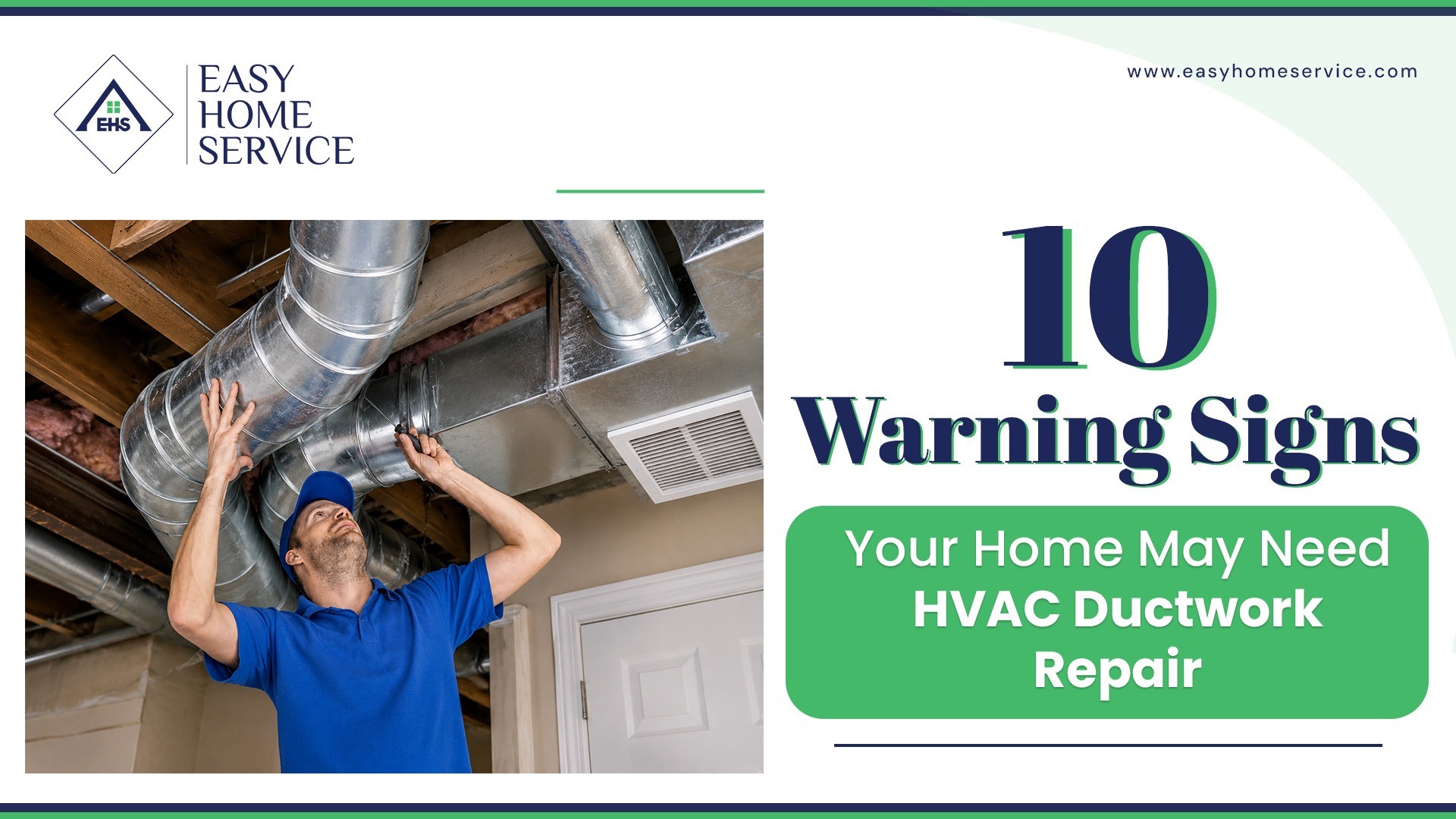
One bedroom never cools down. The hallway feels freezing. The AC runs almost all afternoon, yet your home still doesn't feel comfortable.
Most homeowners assume the air conditioner is failing. In reality, the problem could be hidden inside the ductwork carrying conditioned air through your home.
That was the case for a homeowner in a two-story colonial last winter. The upstairs bedrooms stayed cold no matter how high she turned up the thermostat. Her furnace was only five years old. Her filters were clean. She'd even had a technician check the blower motor twice. The actual problem turned out to be a crushed section of flex duct in the attic, tucked behind insulation where nobody had thought to look.
Stories like this are more common than most homeowners realize. Ductwork failures rarely announce themselves the way a broken furnace does. There's no error code, no sudden shutdown, no obvious moment where something stops working. Instead, the signs show up gradually: a room that's always a little too warm, a bill that's a little too high, a vent that blows a little too weakly. On their own, each sign seems minor. Together, they often indicate that your home's duct system needs professional attention and, in many cases, HVAC ductwork repair to restore efficient airflow and indoor comfort.
This article covers the ten warning signs worth watching for, why they happen, and how to figure out whether your ductwork needs a repair or something more involved.
Your heating and cooling system is only one part of the equation when it comes to keeping your home comfortable. Once the air has been heated or cooled, it still needs an efficient path to reach every room. That's where your home's HVAC ductwork plays a critical role.
Think of ductwork as the delivery system for your HVAC unit. Just as water pipes carry water throughout a home, air conditioning ductwork and heating ducts distribute conditioned air wherever it's needed. When this network is properly designed, sealed, and maintained, each room receives balanced HVAC airflow, allowing your system to maintain a consistent indoor temperature with less effort.
If you're using an air conditioning system or heater, your HVAC device first cools or heats the air according to the temperature you've chosen on the thermostat.
The air that is conditioned travels through a series of supply ducts, which carry it to different rooms within your home. Return ducts return indoor air towards the HVAC system to be cleaned and then conditioned in a continuous process.
When the ductwork is closed and maintained in good working order every room is able to receive adequate airflow. This ensures constant temperatures, enhances the comfort of your home and allows an HVAC system work effectively.
If ducts suffer leaks are disconnected, leaks develop or blocked or crushed, conditioned air may escape before it reaches the living areas. Some rooms might have less airflow than other rooms which can cause different temperatures throughout the house.
To make up for the loss of air In order to compensate, your heating or cooling system is running longer and more often. This can increase energy use also puts more stress the HVAC parts, and can decrease the longevity of the system.
As time passes, damaged ductwork can lead to more expensive energy bills, less airflow, fluctuating indoor temperatures, high levels of dust and a poor overall HVAC performance. Being aware of these issues in the early stages can assist in restoring comfort and increase efficiency before the issue gets more expensive.
Before you dive into the complete list, go through the following five quick questions. You're likely to already know the answers and don't even have to get out of your seat.
Does one room always feel more warm or colder than others in your home?
Do you feel that the air coming from your vents seem fragile?
Do you notice any dust accumulating in your registers or around your vents?
Do you hear a rumble, whistling or banging as the system is running?
Are your utility bills creeping up with no cause?
If you've answered "yes" to at least two of them you're welcome to read the entire list below. The pattern typically indicates an issue with your ductwork, not an isolated fluke This is a good reason to look into getting your ductwork checked by a professional.
This quick check isn't a diagnosis on its own, but it's a useful starting point. Homeowners who answer yes to several of these questions often find, once a technician takes a closer look, that HVAC ductwork repair is exactly what their system needs to get comfort and efficiency back on track.
Your furnace and air conditioner get most of the credit and most of the blame when comfort problems come up, but neither one does much good without a duct system built to move air efficiently. Supply air ducts carry heated or cooled air out to each room. Return air ducts pull air back to the system so it can be reconditioned and sent out again. When that loop works the way it should, you get even air distribution and steady temperatures throughout the house.
When it doesn't, and the ducts are leaking, disconnected, or poorly insulated, your equipment ends up compensating for a problem it can't actually fix. That's often why replacing a furnace or AC unit doesn't solve comfort issues on its own. The new equipment inherits the same broken delivery system the old one had.
If your energy bills have climbed even though your household hasn't changed how it uses heating or cooling, take a look at your ductwork before assuming your equipment is the problem. Duct leakage lets conditioned air escape into unconditioned spaces like attics and crawl spaces, which means your system has to run longer to make up the difference. Over a full season, that lost air adds up to real money.
Uneven heating and uneven cooling are usually the first things homeowners notice, often before they think to blame the ducts at all. Maybe it's the primary bedroom that's always stuffy in summer, or the home office over the garage that never warms up in winter. Hot and cold rooms that show up in the same spots season after season are a strong indicator of an airflow imbalance somewhere in the system, not a fluke of the layout.
Put your hand up to a supply register. If the air feels faint, or if one room's vents feel noticeably weaker than another's, that's worth investigating. Airflow restrictions can come from a variety of places: a kinked flex duct, a disconnected joint, or static pressure that's built up because the ductwork wasn't sized correctly for the system in the first place.
A quiet whoosh when the system kicks on is normal. Rattling, banging, or a persistent whistle is not. Whistling usually means air is being forced through a small gap under pressure, similar to wind whistling through a cracked window frame. Rattling often points to a loose panel or a section of ductwork that's come slightly detached and is vibrating against something nearby.
The duct issue isn't always not visible. If you've been to your crawl space or attic and found a damaged or torn section or if sheet metal ducts exhibit visible rust, that's the most obvious sign you'll find. Flexible ducts are particularly susceptible to breaking or sagging when it was not properly supported when it was installed, and pests sometimes chew through ducts or break connections in older houses.
If cleaning your living space is a routine chore instead of a regular one then your return air ducts may be bringing in more than only the air that circulates through your rooms. Leaky return ducts can pull in insulation fibers, dust and dirt from walls or attics and then move that debris all the way back to your home's ventilation and registers.
Ducts that go through the crawl space are much more susceptible to problems with moisture, and when combined with the build-up of dust in the ductwork could result in mold growth in the course of time. The smell of musty musty that shows particularly when cooling or heating is off is a signal to be taken seriously in both comfort and the quality of your indoor air.
It's easy to overlook because it's not obvious that there's an HVAC issue at first. However, if congestion, sneezing or eye irritation appear more severe at home than elsewhere damaged ductwork might be the reason. The ductwork's gaps can draw in pollutants that never would have been allowed to enter the conditioned air supply and a thorough inspection of your ducts can determine if that's the reason for the case.
Some comfort problems are house-wide. Others are isolated to a single stubborn room, often one at the far end of a long duct run. The farther conditioned air has to travel, the more opportunity there is for it to escape through a leak along the way. If closing vents elsewhere or adjusting the thermostat still doesn't fix that one room, the duct run feeding it is worth a closer look.
Home ductwork isn't built to last forever. In older homes, ducts were sometimes installed with little or no insulation, or sized for a furnace and AC unit that have since been replaced with different equipment. Insulation breaks down. Flex duct sags between supports. Connections that were tight decades ago loosen with time and temperature swings. If it's been years since anyone looked at your ducts, some wear should be expected.
Curious what a real ductwork fix actually looks like, from that first phone call to the finished job? Take a quick look at how it works.
Every gap or seam that isn't sealed properly is an opportunity for conditioned air to escape before it reaches a single room. That's the core reason duct sealing and duct insulation are two of the most effective, and often most affordable, upgrades available for improving HVAC system performance. You're not buying new equipment. You're making sure the air your existing equipment produces actually gets used.
Airflow imbalance is the mechanism behind almost every hot and cold room complaint. When supply ducts leak or return ducts are blocked, the whole system's balance shifts. Air distribution stops matching what each room actually needs, and no amount of thermostat adjusting fully corrects for a physical airflow problem happening behind the walls.
A ventilation system is only as clean as the path the air travels. Damaged ducts create shortcuts for unfiltered air, dust, and occasionally moisture to enter that path. Sealed, well-insulated ductwork keeps that path clean, which matters as much for indoor air quality as it does for temperature control.
This is one of the most common questions homeowners ask once they've noticed a problem, and the honest answer is that it depends on the extent of the damage.
Repair tends to make sense when the ductwork is relatively young, the damage is limited to a few connections or joints, and airflow is generally decent aside from a few weak spots. Replacement becomes the more practical option when ducts are original to a much older home, sheet metal shows significant corrosion, flex duct is torn or sagging in several places, or persistent airflow problems remain even after previous repairs.
A professional duct inspection can help determine whether your ductwork is still worth repairing or if a new HVAC ductwork installation would provide greater comfort, improved energy efficiency, and more balanced airflow throughout your home. Modern duct systems are designed to minimize air leakage, improve air distribution, and support today's high-efficiency HVAC equipment.
One isolated sign from this list might not be urgent. But if you're noticing two, three, or more of these issues at the same time, that combination is a good reason to have your ductwork professionally evaluated rather than waiting it out.
A qualified technician can pinpoint exactly where air is escaping, check whether your ducts are sized correctly, and determine whether insulation or sealing work will resolve the issue. That kind of clarity is hard to get on your own, especially with ductwork that's largely hidden from view.
Finding a technician you trust with something you can't see or check yourself is one of the harder parts of dealing with ductwork problems. Easy Home Service connects homeowners with HVAC professionals who inspect the actual condition of your ducts instead of guessing based on symptoms alone.
That starts with a real inspection, not a sales pitch. A technician looks at your duct runs, checks for leaks, damage, and sizing issues, and explains what they find in terms you can understand. From there, you get a straightforward recommendation on whether a repair will solve the problem or whether replacement makes more sense, along with what each option involves.
Homeowners aren't left to figure out on their own whether a noise, a cold room, or a rising bill is worth worrying about. Easy Home Service handles the diagnosis and the fix, so you're not stuck piecing together the answer from a list of symptoms.
Most ductwork problems don't happen overnight. They build slowly through small leaks, loosened connections, and insulation that wears thin over years of use. The advantage of knowing these warning signs is catching the problem while it's still a straightforward fix rather than letting it turn into a bigger, more expensive one.
If several of these signs sound familiar in your own home, it's worth scheduling HVAC ductwork repair rather than living with the extra cost and discomfort. Easy Home Service provides HVAC ductwork services for homeowners who want their system inspected, sealed, or repaired properly, alongside broader HVAC services covering air conditioning, heating, and indoor air quality needs across the home.
Every day you wait, you're paying for air that never reaches your rooms. Get your ductwork inspected and repaired by a professional now.
Find Top Rated Service Providers
We help you find top service providers and compare quotes.










Leave a Comment: