Your Go-To for Complete Home Solutions and Trusted Excellence
Your Go-To for Complete Home Solutions and Trusted Excellence
HVAC

By Ar. Daisy,
July 13, 2026


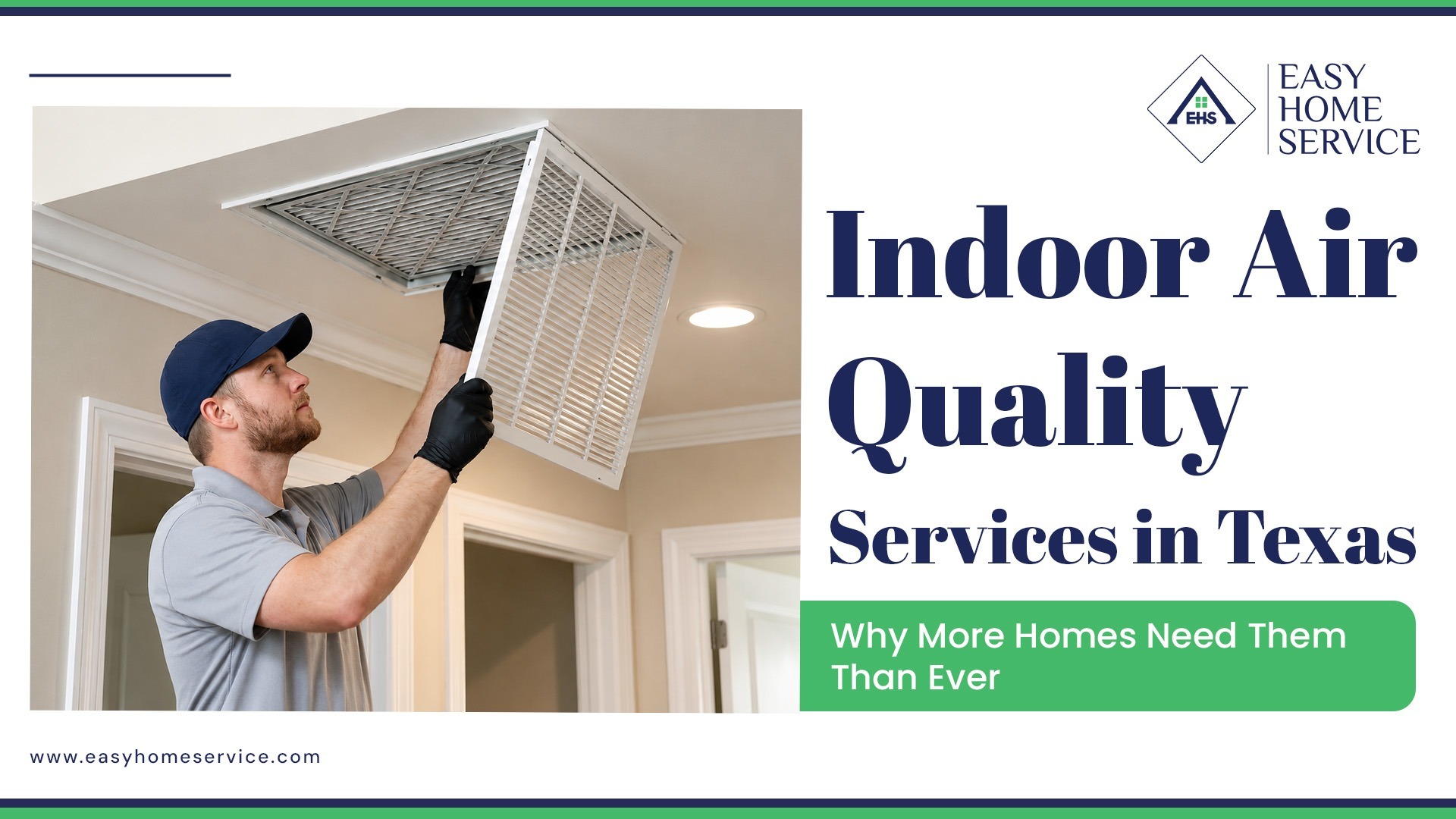
Texas summers are long, the air is thick with humidity for months at a time, and most homes' HVAC systems scarcely get a break between April and October. All of this adds up to something homeowners rarely consider until a problem arises: the air circulating throughout their home.
Indoor air quality has quietly become one of the biggest concerns in home health. People spend most of their day indoors, and the air inside a home can carry more dust, allergens, and pollutants than the air outside it. Texas homeowners face a particular version of this challenge, shaped by heat, humidity, pollen, and a climate that keeps HVAC systems running almost year round.
This guide covers what indoor air quality means, why Texas homes are especially prone to poor IAQ, and which services make the biggest difference, along with where Easy Home Service can help homeowners take practical steps toward cleaner, healthier air.
Texas weather doesn't do your air any favors. Between the humidity, the pollen, and how long your AC has to run each year, there's a lot working against clean indoor air here.
Anyone who's lived through a Texas summer knows the air outside can feel thick enough to wear. That moisture doesn't stop at your front door. It seeps into walls, attics, and ductwork, and once it settles in, it doesn't leave easily. Homes near the Gulf Coast deal with this more than most, but honestly, few parts of the state are spared.
Where there's humidity, mold usually isn't far behind. It doesn't need much to get started, just a damp corner, a slow leak, or ducts that never quite dry out. Once it takes hold, your HVAC system can end up doing the opposite of its job, pushing spores through the house instead of clean air.
Texas allergy sufferers already know this one too well. Cedar in the winter, oak in the spring, grass through the summer. It feels like there's barely a break. Even with windows shut, pollen finds its way in through vents, door gaps, and every time someone walks in from outside.
Between dry stretches, wind, and construction happening in growing cities across the state, dust is a constant. It settles on furniture fast, but the bigger issue is what's building up inside your ductwork where you can't see it, getting stirred up and recirculated every time the system kicks on.
This one catches people off guard. Fires burning hundreds of miles away, sometimes in other states, can still send smoke drifting over Texas skies for days. That smoke carries fine particles small enough to slip past a basic filter and settle indoors long after the haze outside has cleared.
In much of Texas, air conditioning isn't a seasonal thing. It runs for the better part of eight or nine months, sometimes longer depending on the year. All that runtime means filters clog faster, dust builds up quicker, and the system gets far less downtime to recover than it would somewhere with milder weather. Over time, that adds up.
Texas homeowners are faced with specific indoor air quality challenges due to the high humidity as well as seasonal pollen, dust and mould growth and prolonged HVAC operating times. Knowing the common indoor air quality problems in Texas homes can help you pick the best solution before they impact your family's health and comfort.
Many Texas homeowners are suffering from low indoor air quality and don't even realize it. If any of these sound familiar, you should consider having your air inspected.
Signs to watch for:
If any of these sound familiar, it may be time to look into a professional evaluation rather than continuing to manage the symptoms one at a time.
Every home is a little different, and the right fix depends on what's actually going on inside your ducts and HVAC system. A quick conversation with our team can point you in the right direction before you spend money guessing.
A comprehensive home air purifier functions in tandem with your HVAC system to trap particles that regular filters frequently overlook, such as fine particulate matter, remnants of wildfire smoke, seasonal allergens, and pet dander that circulates throughout the home continuously. Unlike a portable device that services just one room, it seamlessly integrates into the HVAC system, ensuring the air that flows through the entire house is treated every time the system operates. For Texas homes facing intense pollen seasons or nearby wildfire smoke, this type of steady filtration can significantly enhance the overall comfort of the home day by day.
If dust, allergies, or smoke exposure have become a recurring issue in your household, Easy Home Service can walk you through which purifier option fits your home and your budget.
Before recommending any fix, a proper evaluation starts with testing. HVAC air quality testing typically covers VOC testing to identify chemical compounds in the air, particle testing to measure dust and allergen levels, and humidity measurement to assess moisture buildup. An inspection ties these results together and gives homeowners a clear picture of what is actually happening inside their house, rather than relying on guesswork. This step is especially useful for older homes or homes that have recently gone through renovation, since both situations can introduce new sources of airborne contaminants.
Upgrading the filtration in your HVAC system is one of the most cost-effective ways to improve indoor air quality. Better filters trap more particles before they reach the living spaces of your home, and whole home filtration systems take this further by treating all the air moving through the ductwork rather than what passes through a single filter slot.
MERV ratings are a useful benchmark here. Higher MERV-rated filters catch smaller particles, which matters for households dealing with allergies, pet dander, or nearby industrial and traffic pollution, though higher rated filters can restrict airflow if the system is not designed to handle them. Matching the right filter to your setup results in cleaner air and smoother, more consistent airflow throughout the home.
Over time, ductwork collects dust, mold spores, and in some cases construction debris left behind from a remodel or new build, and every time the HVAC system runs, that buildup gets pushed into every connected room. Duct cleaning removes this accumulated material and restores proper airflow. Homes that have gone through recent construction, have pets, or have not had duct maintenance in several years tend to see the biggest improvement, and clear ducts also mean the HVAC system does not have to work as hard.
Given how much Texas humidity contributes to indoor air quality problems, humidity control deserves its own place on this list. Whole home dehumidifiers work with the HVAC system to keep moisture levels balanced year round, rather than leaving certain rooms damp while others stay dry. Managing humidity is one of the most effective ways to prevent mold growth before it starts, since mold needs sustained moisture to establish itself, and balanced humidity also improves comfort and takes some of the cooling strain off the system.
Investing in required HVAC services offers advantages that extend beyond simply facilitating easier breathing. Homeowners addressing IAQ problems notice enhanced breathing, reduced allergy symptoms, and a generally cleaner home since there is less dust accumulation on furniture and surfaces. The HVAC system also enjoys practical advantages, as reducing debris passing through it generally enhances the longevity and efficiency of the equipment. Numerous households experience more uniform temperatures and humidity across different rooms, along with reduced persistent odors from cooking, pets, or everyday activities.
Cost is often the first thing homeowners inquire about when they've determined that the indoor air they have needs assistance, and it's certainly an appropriate one. The cost varies based on the size of your house and the severity of the issue, as well as the service you select However, here's a fair overview of the amount Texas homeowners spend to get each repair.
A typical Indoor air quality testing for a typical Texas home is usually between $200 and $800. Basic testing that covers the most common particulates as well as general air quality tests are at a lower level between $200 and $400. When you begin adding samples of mold, VOC testing, or allergen screening, the cost increases to $400-$700 range. Testing for specific substances such as formaldehyde or radon can go over $1,000, especially in older or larger properties where more sampling sites are required. Areas with high humidity levels such as Houston and areas along the Gulf Coast often need a little more screening for mold, which could increase the cost little compared to the drier areas in the State.
Air duct cleaning in Texas generally costs between $300 and $700 for a typical single family home, though larger homes with more vents and longer duct runs can run higher. Homes that haven't had their ducts cleaned in several years, or that recently went through a renovation, sometimes need more time and labor, which adds to the cost. It's one of the more affordable indoor air quality services on this list, and often one of the first places homeowners start.
Whole-home air purifiers that tie directly into your HVAC system typically cost more upfront than portable units, usually somewhere in the range of $600 to $2,500 including installation. The exact price depends on the type of purification technology used and how large the system needs to be to cover your home's square footage. It's a bigger investment than testing or duct cleaning, but it works continuously in the background rather than needing to be moved room to room.
Upgrading to HEPA level filtration, or a high MERV rated filter that gets close to HEPA performance, generally costs somewhere between $300 and $1,000 depending on whether your existing HVAC system can handle it as is or needs modification. Some older systems need additional work to accommodate stronger filtration without restricting airflow, which can add to the price.
Whole-home dehumidifiers that connect to your HVAC system typically cost between $1,200 and $2,800 when installed. Due to the fact that humidity can cause the growth of mold in Texas particularly close to the coast This is one of the services that homeowners living in areas with high humidity typically see the most rapid return on because it can help avoid the much more costly issue of remediation of mold later on.
A few things consistently affect what you'll pay across all of these services: the square footage of your home, how many HVAC zones or systems you have, how accessible your ductwork is, and how far along a problem already is before you call someone. Catching an issue early, whether that's mold, humidity, or a struggling filtration system, almost always costs less than waiting until it's a bigger repair.
If you're not sure which of these services your home actually needs, a professional indoor air quality assessment is usually the most cost effective place to start. It tells you exactly what's going on before you spend money guessing.
Indoor air quality and HVAC performance are inextricably linked, and problems in one typically manifest in the other. Dirty filters impede airflow, forcing the system to work harder to pump air through the house, which puts additional strain on the blower motor and compressor, potentially shortening their lifespan. The same chain of cause and effect shows up on utility bills too, since a system fighting poor airflow uses more energy to do the same job. Preventative maintenance, including regular filter changes and periodic duct inspections, is one of the simplest ways to avoid this cycle before it starts.
If it has been a while since your HVAC system had a full inspection, Easy Home Service offers evaluations that check both system performance and air quality at the same time, giving you a complete picture rather than just a partial fix.
Indoor air quality issues can be tempting to address with a store-bought filter or a portable purifier from a local retailer. Those options have their place, but they rarely solve the underlying problem in a home with more significant air quality challenges. Professional HVAC service brings proper equipment designed for whole-home use, along with accurate testing that identifies exactly what is in your air rather than guessing. That accuracy matters for correct product selection, since a filtration system or purifier that is mismatched to your HVAC setup will not perform the way it should, and safe installation matters too for systems that need to integrate cleanly with existing ductwork and equipment. It all adds up to results that a temporary fix cannot match.
Each home requires a unique approach, and the ideal solution typically relies on the house's particular situation. Aging houses often contain ductwork that hasn't been cleaned and might have gaps or leaks allowing outside air to avoid filtration, making them more prone to improvement through duct cleaning and enhanced filtration. Newly built homes may have residual dust and emissions from fresh materials, so conducting an initial air quality test is a wiAgeingse first move. Residences with pets gather dander and hair in duct systems more quickly than normal, often necessitating more regular filter replacements and enhanced filtration. Individuals with allergies typically gain the most advantages from a comprehensive home air purifier combined with enhanced filtration
A handful of moments make particular sense for scheduling an inspection. After remodelling, construction dust and new materials can significantly affect a home's air, and moving into a new home is a natural checkpoint since you have no history of how the previous owners maintained the system. Persistent allergies that do not improve with typical seasonal changes may point to an indoor source rather than outdoor pollen. Water damage, even a minor slow leak, creates the moisture that leads to mold, and smoke exposure from a nearby wildfire or an event inside the home can leave residue in ductwork long after the smoke clears. Finally, annual HVAC preventive maintenance is a good time to fold in an air quality check while the technician is already inspecting the system.
Homeowners can no longer ignore indoor air quality issues. In Texas, the combination of high humidity, extended HVAC operation, strong pollen seasons, and occasional wildfire smoke makes air quality prevention more crucial than in many other regions of the nation. The positive aspect is that minor, focused enhancements, such as improved filtration, a comprehensive home purifier, enhanced humidity regulation, or basic duct cleaning, can significantly enhance the healthiness of your living environment.
If your home has been struggling with dust, allergens, smells, or an HVAC system that seems to be overworking, Easy Home Service can assist you in determining precisely what your home requires, from assessment to installation.
From testing to duct cleaning to whole-home purification, Easy Home Service can walk you through exactly what your Texas home needs and handle the work from start to finish. Take the first step toward cleaner, healthier air today.
Find Top Rated Service Providers
We help you find top service providers and compare quotes.







Leave a Comment: