Your Go-To for Complete Home Solutions and Trusted Excellence
Your Go-To for Complete Home Solutions and Trusted Excellence
HVAC

By Ar. Daisy,
November 10, 2026


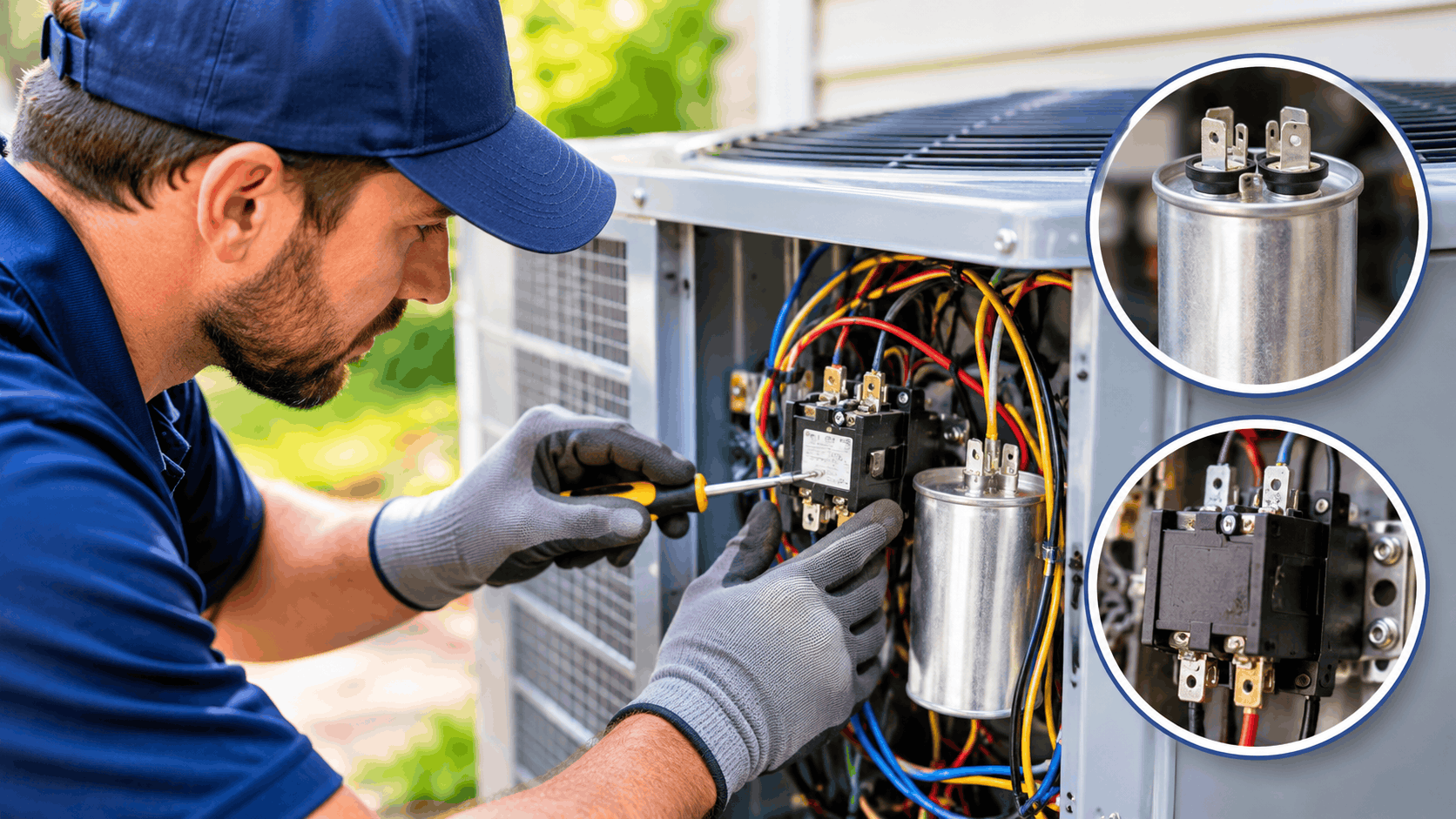
It’s the middle of July. The thermostat says 72, the house is creeping toward 85, and the outdoor unit is either buzzing like it’s thinking something over or sitting completely still. Before you start pricing out a new system, look at two small electrical parts that cause a lot of no-cool calls: the capacitor and the contactor.
HVAC capacitor and contactor repair is one of the more affordable fixes in air conditioning. It is usually finished in a single visit, and the parts themselves cost less than a family dinner out. The catch is that the symptoms (a unit that hums, clicks, or won’t start) look a lot like bigger problems, and ignoring them can turn a few-hundred-dollar repair into a compressor replacement.
This guide covers what each part does, how to tell which one is acting up, how technicians test and replace them, what the work costs, and when it’s time to bring in HVAC professionals.
A capacitor provides the electrical shove that your motors require to start and continue rotating. When your thermostat requests cooling, a contactor activates the outdoor unit's power supply. Humming is a common indicator of capacitor failure. Contactor problems are typically characterised by clicking, chattering, or silence.
A heating and air conditioning system is mostly motors: a compressor, a condenser fan outside, and a blower inside. Motors that size don’t start well on their own, and they need to be switched on and off hundreds of times a season. Those two jobs belong to the capacitor and the contactor.
A capacitor stores a small charge of electricity and releases it at the right moment. That burst helps a motor get moving, and a steady supply keeps it running smoothly afterward. As a capacitor ages, it holds less charge. The motor still gets power, but not the kind of help it needs, so it struggles, overheats, or refuses to turn.
Your thermostat doesn’t send 240 volts to the outdoor unit. It sends a gentle 24-volt signal to a coil inside the contactor, which pulls a pair of metal contacts together and closes the high-voltage circuit. When the house is cool enough, the coil lets go and the contacts open. Every cooling cycle is one more time those contacts make and break a heavy electrical connection, and over thousands of cycles they pit, burn, or stick.
The same parts live in heat pump outdoor units, so they work in winter too. Furnaces and air handlers use their own blower motor capacitors. If you rely on one company for heating and cooling services, this is a shared weak point across both seasons.
Not every capacitor is the same, and the type affects both the symptoms and the repair.
|
Type |
What it does |
Where you’ll find it |
|
Run capacitor |
Keeps a single motor running efficiently |
Condenser fan motor, indoor blower motor |
|
Dual-run capacitor |
One can that serves both the compressor and the condenser fan |
Most residential outdoor units; three terminals labeled HERM, FAN and C |
|
Start capacitor |
Gives a compressor a short, strong boost to get going |
Larger or hard-starting compressors, often as part of a hard-start kit |
Every capacitor carries two numbers that matter: capacitance in microfarads (µF) and a voltage rating, commonly 370V or 440V. The µF value has to match the original. The voltage can match or run higher, but never lower. A 440V capacitor can stand in for a 370V one, and the reverse is not safe.
AC capacitor failure symptoms tend to creep up. A weak capacitor can limp along for weeks, working fine on mild days and quitting on the hottest one. Watch for these HVAC capacitor failure symptoms:
Humming or buzzing from the outdoor unit while the fan or compressor stays still. The motor has power but no starting help.
A fan that is slow to get up to speed, or one that spins noticeably slower than it used to.
An AC that won’t turn on, or shuts down partway through a cycle. An overheating motor trips its internal protection.
Warm air from the vents while the indoor blower runs and the outdoor unit hums.
Higher electric bills and longer run times. Motors fighting a weak capacitor draw more current.
A swollen, domed, or leaking capacitor. A technician can spot this at a glance. It is not something to confirm by touch.
Heat is the main enemy here. Capacitors installed in hot climates or in units that run long hours tend to wear out sooner, and power surges shorten their lives further. Capacitors commonly last somewhere between five and fifteen years, with harsh conditions pushing toward the short end.
Bad HVAC contactor symptoms are usually more mechanical than electrical. You hear something, or you notice a unit doing something it shouldn’t.
A click at the outdoor unit, then nothing. The coil is pulling in, but power isn’t getting through the contacts.
Rapid chattering or buzzing. The coil may be weak, or the control voltage may be low.
An outdoor unit that won’t start while the indoor blower runs normally.
A unit that won’t shut off. Contacts that have welded themselves closed keep the compressor and fan running after the thermostat is satisfied. Turn the system off at the thermostat, and if the outdoor unit keeps running, shut it off at the breaker and call for service.
Burned, pitted, or melted contacts found during inspection. Insects, moisture, and debris inside the unit contribute.
Contactors often last ten years or more, but frequent cycling, storms, and a power supply that isn’t stable can wear them out faster.
Most homeowners don’t search for “contactor.” They search for what they’re hearing: AC not turning on, air conditioner clicking but not starting, AC humming but not starting. This table matches the symptom to the likely cause.
|
What you notice |
Most likely culprit |
Why it happens |
|
Outdoor unit hums, fan or compressor doesn’t turn |
Capacitor |
Motor gets power but no starting boost |
|
Fan spins slowly or struggles to reach speed |
Capacitor |
Weak run capacitor |
|
AC clicking but not turning on, nothing starts |
Contactor first; capacitor or compressor if the contactor checks out |
Contacts not closing, or a compressor that can’t start |
|
Rapid chattering from the outdoor unit |
Contactor or low control voltage |
Coil receiving a weak signal |
|
Outdoor unit keeps running after the thermostat is satisfied |
Contactor |
Contacts welded closed |
|
AC compressor not starting, breaker trips |
Capacitor, compressor, or wiring |
Startup current is too high or the motor is failing |
A few quick checks are safe for any homeowner. Confirm the thermostat is set to cool and set below the room temperature. Check that the breaker hasn’t tripped and the outdoor disconnect is fully in place. Swap the thermostat batteries if it has them, and replace a clogged air filter. If all of that checks out, stop there. Removing the access panel on an outdoor unit exposes live 240-volt wiring, and capacitors can hold a charge even with the power off.
The one that deserves extra attention is an AC compressor not starting. It might be a capacitor or contactor problem, but it can also mean the compressor itself is failing. Running it repeatedly in that state is how a cheap repair becomes an expensive one.
A faulty capacitor or contactor can leave your entire cooling system struggling. Don't let a small electrical issue turn into an uncomfortable day at home. Explore Easy Home Service to connect with HVAC professionals who can help you find the right repair solution.
Accurate diagnosis is an important part of HVAC capacitor and contactor repair. A professional should investigate the electrical circuit instead of assuming that the first visible symptom identifies the failed component.
A technician may:
Inspect the capacitor for swelling, leakage, corrosion, or visible damage.
Check the equipment specifications and the capacitor's marked ratings.
Follow the required electrical isolation and stored-energy safety procedures.
Measure capacitance with an appropriate meter.
Compare the measurement with the component's marked value and tolerance.
Inspect associated wiring, motor connections, and operating conditions.
A capacitor that measures outside its specified tolerance may require replacement. However, the technician should also investigate abnormal voltage, motor problems, and other conditions that could have contributed to the failure.
Contactor testing generally involves inspecting:
These checks help determine whether the contactor itself is defective or whether another problem is preventing it from operating correctly.
Safety note: Capacitors can store harmful electrical energy even after the equipment is turned off. Contactors and neighbouring terminals may also carry harmful voltage. Testing, isolation, and replacement should be performed by a qualified HVAC specialist following proper safety measures. Homeowners should avoid using a tool to test live electrical circuits or short capacitor connections.
Capacitors and contactors are not the only parts that can leave you with a silent outdoor unit. Some of the other common HVAC electrical problems look nearly identical from the driveway:
A failing fan or compressor motor. Worn bearings or damaged windings make the motor draw excess current, which can kill a new capacitor in short order.
A tripped safety switch. A clogged condensate line can trip an overflow switch that cuts power to the system, so the AC isn’t turning on even though nothing outside is broken.
A weak control transformer or low 24-volt signal. The contactor can’t pull in firmly, which causes chatter or no-start.
Loose or corroded wiring. Heat and moisture work on connections over time.
A blown fuse or tripped breaker. Sometimes a symptom of the problems above rather than the problem itself.
This is the reason a diagnosis matters. Swapping a capacitor without finding out why it failed is how homeowners end up with a repeat breakdown a month later.
The cost of air conditioner capacitor replacement is mostly diagnosis and labor, not the part. Based on national cost guides reviewed in November 2026, typical ranges look like this:
|
Repair |
Part alone |
Typical total with labor |
|
Capacitor replacement |
About $10–$50 |
About $150–$ 450 |
|
Contactor replacement |
About $20–$ 100 |
About $150–$ 450 |
Two other charges often show up on the invoice. Many companies charge a service call or diagnostic fee of roughly $75 to $200, and some apply it toward the repair. Emergency labor on nights, weekends, and holidays often runs $160 to $250 an hour or more, compared with $75 to $150 an hour during regular hours.
What moves the price within those ranges:
Capacitor type. A dual-run capacitor costs a little more than a single run capacitor, and a start capacitor or hard-start kit adds to the bill.
Access and system size. Larger units and tight installations take more time and bigger parts.
Timing. Repairs are often cheaper in spring and fall, when demand is lower. Waiting until a heat wave means emergency pricing and a longer line.
Warranty. A manufacturer’s warranty might cover the part but not the labor.
Location. Labor rates run higher in high-cost metro areas.
In short, HVAC capacitor replacement cost and AC contactor repair cost are both modest compared with what’s at risk. A compressor that has been run on a bad capacitor or a stuck contactor often costs well into the thousands to repair, and at that point the conversation can shift to replacing the whole system. A few hundred dollars now is the cheap end of that choice.
Some HVAC problems can wait for a convenient appointment. These can’t:
In every one of those cases, turn the system off at the thermostat, and don’t keep resetting the breaker. A motor that keeps trying to start under a failed capacitor overheats, and an overheated motor is a more expensive repair than a capacitor.
Why not do it yourself? A capacitor can hold a charge even when the power is off, and the outdoor unit carries 240 volts. A wrong part or a misplaced wire can ruin a compressor. For professional AC repair, the extra cost of a technician buys a correct diagnosis, the right part, and a test that proves the repair worked.
Weather and seasonal operating patterns can influence how often homeowners use their heating and cooling equipment. However, electrical component failures can occur in any region, and symptoms alone cannot identify the cause.
Alabama (AL): Long, hot, humid periods can mean extended air conditioning operation. Homeowners should pay attention to unusual humming, repeated starting attempts, or inconsistent outdoor-unit operation.
Arizona (AZ): High summer temperatures can place substantial operating demands on cooling equipment. A sudden loss of cooling or an outdoor unit that struggles to start deserves prompt attention.
Indiana (IN): Heating and cooling systems may experience seasonal changes between cooling and heating operation. Before the cooling season, checking outdoor electrical components as part of professional maintenance can help identify developing problems.
Kentucky (KY): Hot, humid summers can increase cooling demand. Clicking sounds, irregular starts, and reduced cooling performance are reasons to arrange an inspection.
New York (NY): Seasonal temperature changes mean many homes rely on different heating and cooling configurations throughout the year. Proper inspection of the relevant HVAC equipment helps identify electrical issues before heavy seasonal use.
Whether a home is in Alabama, Arizona, Indiana, Kentucky, or New York, the correct repair depends on the actual equipment condition rather than the state alone.
You can’t make these parts last forever, but a few habits improve the odds. These HVAC system maintenance tips are inexpensive compared with an emergency call.
Book a tune-up before your heaviest season. Ask the technician to test capacitor µF against the label and inspect the contactor contacts. HVAC maintenance services catch weak parts while they still work.
Replace borderline capacitors early. If one tests near the edge of tolerance, the heat of summer will finish it.
Keep the outdoor unit clear. Trim plants back and clear leaves and debris so the unit can shed heat. Insects and moisture are hard on contactors.
Keep the air filter fresh and the coils clean. Less strain on the system means less strain on the motors and capacitors.
Consider surge protection. Storms and grid fluctuations damage electrical components over time, and a surge protector at the unit or panel helps.
Don’t ignore early signs. Humming, clicking, slow starts, or a system that needs a second try are cheaper to fix on day one than day thirty.
Whether your AC won't start, keeps clicking, or struggles to stay running, the problem could be hiding in its capacitor or contactor. Explore your HVAC service options with Easy Home Service and take the next step toward a comfortable home.
If your outdoor unit is humming, clicking, or refusing to start, don’t wait for a small electrical part to turn into a major repair bill. Easy Home Service connects homeowners in Alabama, Arizona, Indiana, Kentucky, and New York with qualified HVAC professionals who can diagnose capacitor and contactor problems and get your system running again.
Request service through Easy Home Service today, and describe what you’re seeing and hearing so your technician arrives prepared.
Find Top Rated Service Providers
We help you find top service providers and compare quotes.




Leave a Comment: